
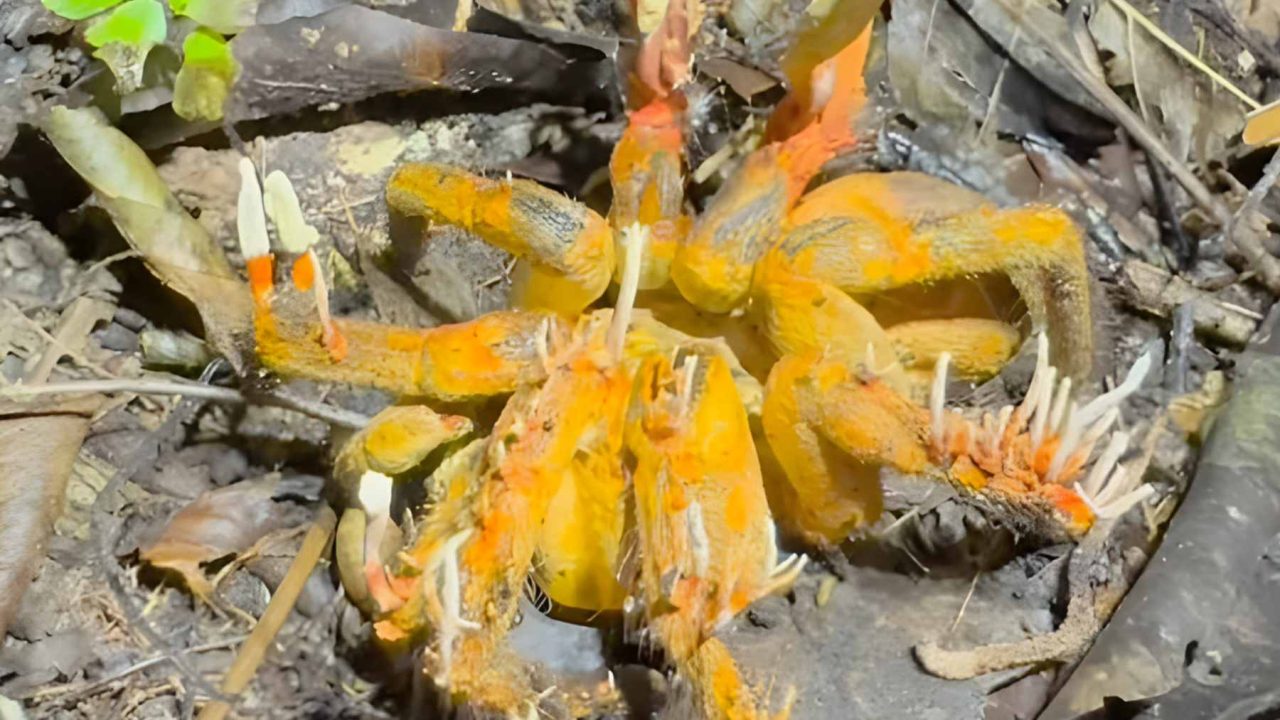
Deep in the Amazon rainforest, a research team stumbled across something that looks almost too strange to be real — a giant tarantula, visibly infected by a parasitic fungus, preserved well enough to raise serious scientific questions about what else might be hiding in one of Earth’s least-explored ecosystems.
The discovery was made in January during fieldwork at the Ducke Reserve near Manaus, Brazil. A team connected to three institutions — the Federal University of Santa Catarina (UFSC), the University of Copenhagen (UCPH), and Brazil’s National Institute for Amazonian Research (Inpa) — documented a specimen of Cordyceps caloceroides, a parasitic fungus, growing from a tarantula identified as Theraphosa blondii. That species is more commonly known as the Goliath birdeater, one of the largest spiders in the world by mass.
It sounds like the premise of a horror film. But scientists say the real story here is about biodiversity, not catastrophe — and why a single infected spider can matter enormously to the broader scientific record.
What Was Actually Found in the Amazon
The find was made by Lara Fritzsche, an Environmental Science student at the University of Copenhagen, who spotted the parasite and its host during the tropical fieldwork expedition. That a student made the observation is itself worth noting — it speaks to the kind of careful, ground-level attention that produces rare discoveries in environments as dense and complex as the Amazon.
The fungus involved, Cordyceps caloceroides, belongs to a group of fungi that have fascinated scientists for decades. Cordyceps species are known for infecting arthropods — insects, spiders, and their relatives — and manipulating or killing their hosts as part of their reproductive cycle. The infected tarantula found at the Ducke Reserve represents an unusually well-documented case of this phenomenon occurring in one of the world’s most biodiverse regions.
Researchers described the specimen as unusually well preserved. That matters more than it might sound. A well-preserved specimen allows for detailed morphological study — the physical examination of structure and form — as well as molecular analysis. It also opens the door to questions about whether what scientists currently classify as a single species might actually be several distinct ones hiding under the same name.
Why the Cordyceps-Tarantula Discovery Raises So Many Questions
Cordyceps fungi infecting large spiders like the Goliath birdeater are rarely documented with this level of physical preservation. That rarity alone makes the find scientifically significant. But the questions it raises go deeper than one specimen.
The Amazon remains one of the most species-rich and least fully cataloged places on Earth. Every well-documented find from its forest floor adds another data point to a picture that scientists are still very much assembling. Researchers have noted that a discovery like this can illuminate how much forest life remains uncataloged — and how much may be lost before it is ever formally identified.
There is also the taxonomic question. The possibility that more than one species may be hiding under the same scientific name is a recurring challenge in biology, particularly in tropical ecosystems where physical access is difficult and specimens are rarely collected in ideal condition. A well-preserved infected tarantula gives researchers material to work with that most field expeditions simply do not produce.
Key Facts About the Discovery at a Glance
| Detail | Information |
|---|---|
| Location | Ducke Reserve, near Manaus, Brazil |
| Date of fieldwork | January (year of publication: 2026) |
| Fungus identified | Cordyceps caloceroides |
| Host species | Theraphosa blondii (Goliath birdeater tarantula) |
| Institutions involved | UFSC (Brazil), UCPH (Denmark), Inpa (Brazil) |
| Discoverer | Lara Fritzsche, Environmental Science student, UCPH |
| Condition of specimen | Unusually well preserved |
- The Ducke Reserve is a protected area of Amazon rainforest managed for scientific research near Manaus.
- Theraphosa blondii is widely considered one of the largest spiders on Earth by body mass and leg span.
- Cordyceps fungi are known for infecting arthropods and are found across tropical regions globally.
- The specimen’s preservation quality makes it viable for both physical and molecular scientific analysis.
Why This Find Matters Beyond the Headlines
It would be easy to look at this story as a curiosity — a creepy image of a fungus-covered spider that briefly circulates on social media and disappears. But the scientific community sees it differently.
Finds like this one are part of a much larger effort to understand what lives in tropical forests before those environments change further. The Amazon is under sustained pressure from deforestation, climate shifts, and land use changes. Species — and the ecological relationships between them, like the one between Cordyceps fungi and their spider hosts — can disappear before they are ever properly studied.
A single well-preserved specimen, found by a student on a field expedition, can anchor years of follow-up research. It can help clarify species boundaries, support molecular studies, and contribute to a baseline understanding of fungal biodiversity in one of the world’s most important ecosystems. That is not a small thing.
What Researchers Will Be Looking at Next
Based on what Scientists have flagged the possibility that taxonomic questions — specifically, whether multiple species are currently grouped under a single name — could be explored using material like this.
The involvement of three institutions across two countries also suggests that collaborative follow-up work is likely. Whether that produces formal taxonomic revisions, new species descriptions, or deeper insight into how Cordyceps fungi interact with large arachnids in Amazonian ecosystems remains to be seen. What is clear is that the researchers involved consider this find rare enough to warrant serious scientific attention.
Fieldwork in places like the Ducke Reserve continues to produce surprises. That is partly a testament to how much the Amazon still holds — and how much depends on researchers, and students, willing to look carefully at the forest floor.
Frequently Asked Questions
What is Cordyceps caloceroides?
It is a parasitic fungus documented infecting arthropods, including spiders. It belongs to the broader Cordyceps group, which is known for infecting and killing insect and arachnid hosts as part of its reproductive process.
What is Theraphosa blondii?
Theraphosa blondii, commonly known as the Goliath birdeater, is one of the largest spiders in the world by mass and is native to South American rainforests including the Amazon.
Where exactly was the infected tarantula found?
The specimen was found at the Ducke Reserve near Manaus, Brazil, during fieldwork conducted in January 2026.
Who discovered the infected tarantula?
Lara Fritzsche, an Environmental Science student at the University of Copenhagen, spotted the parasite and its host during the expedition.
Is this type of Cordyceps infection dangerous to humans?
Researchers described this as a biodiversity discovery, not a public health concern.
What will scientists do with the specimen?
Researchers have noted the specimen’s unusually good preservation makes it suitable for morphological and molecular analysis, and it may help clarify whether more than one species is currently grouped under the same scientific name.




Leave a Reply